Skip to content

ListeningHead.com

  • Home
  • About Jonathan Ginsberg
  • Interesting Readings
    • A Message to Garcia
    • Palestine 1917 – British Mandate
  • Blog

Carnegie Deli Partner Dies at 90 – Rest in Peace Milton Parker

February 7, 2009 by jginsberg

The AP reports today that Milton Parker, a co-0wner of New York City’s most famous restaurant, the Carnegie Deli, has passed away at age 90.  The cause of death was “respiratory failure” which most likely means that he died of old age.  Not a stroke, not a heart attack, not cancer, not diabetes.  A short, portly gentleman, Mr. Parker most likely consumed meat every day.  What does this tell us?  I will take good genes over good greens any day of the week.

I live in Atlanta, Georgia, but my wife, kids and I generally visit New York City at least once a year.  No stop in the City would be complete without a visit to the Carnegie for a giant corned beef sandwich.  Thanks to my friend Howard Beer for alerting me to Mr.  Parker’s passing.
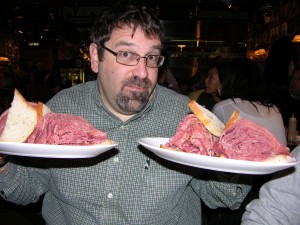
corned beef sandwich at the Carnegie Deli
Carnegie Deli Corned Beef Sandwich

Filed Under: Miscellaneous observations Tagged With: Carnegie Deli, corned beef sandwich, Milton Parker

Private Performance for Russia’s Powerful Putin

February 6, 2009 by jginsberg

Australia’s news.com.au reports that Russia’s Vladamir Putin arranged for an Abba cover band called “Bjorn Again” to fly form London to Moscow, then from Moscow via a 9 hour bus ride to a remote military barracks to play a 1 hour set of Abba tunes for former Russian president Putin and a female companion seated behind a curtain.  For its services, the band was paid $45,000, reportedly paid for by the Russian government.

To quote Mel Brooks from History of the World Part I – “its good to be the king.”

Filed Under: Russia Tagged With: Abba, Bjorn Again, Putin

Obama and Treatment of Terror Suspects – Minimal Change from Bush Administration Policy?

February 4, 2009 by jginsberg

By Fred Burton and Ben West
reprinted with permission from Stratfor.com

U.S. President Barack Obama signed an executive order Feb. 1 approving the continued use of renditions by the CIA. The order seems to go against Obama’s campaign promises to improve the image of the United States abroad, as renditions under the Bush administration had drawn criticism worldwide, especially from members of the European Union. The executive order does not necessarily mean that renditions and other tactics for dealing with terrorist suspects will proceed unchanged, however.

Obama came into office promising changes in the way the United States combats terrorism. One of these changes was a new emphasis on legal processes and a shift away from controversial methods of treating terrorist suspects, like rendition, harsh interrogation techniques and secret prisons. The Obama administration can and will roll back some of these tactics, as demonstrated by the president’s Jan. 22 order to close the detention center at Guantanamo Bay. But some will continue. [Read more…]

Filed Under: Obama Administration, The Presidency Tagged With: counterterrorism, redention, water-boarding

The Russians Welcome President Obama With Immediate Crisis

January 20, 2009 by jginsberg

By George Friedman
Reprinted with permission from Stratfor

U.S. President-elect Barack Obama will be sworn in on Tuesday as president of the United States. Candidate Obama said much about what he would do as president; now we will see what President Obama actually does. The most important issue Obama will face will be the economy, something he did not anticipate through most of his campaign. The first hundred days of his presidency thus will revolve around getting a stimulus package passed. But Obama also is now in the great game of global competition — and in that game, presidents rarely get to set the agenda.

The major challenge he faces is not Gaza; the Israeli-Palestinian dispute is not one any U.S. president intervenes in unless he wants to experience pain. As we have explained, that is an intractable conflict to which there is no real solution. Certainly, Obama will fight being drawn into mediating the Israeli-Palestinian conflict during his first hundred days in office. He undoubtedly will send the obligatory Middle East envoy, who will spend time with all the parties, make suitable speeches and extract meaningless concessions from all sides. This envoy will establish some sort of process to which everyone will cynically commit, knowing it will go nowhere. Such a mission is not involvement — it is the alternative to involvement, and the reason presidents appoint Middle East envoys. Obama can avoid the Gaza crisis, and he will do so.

Obama’s Two Unavoidable Crises

The two crises that cannot be avoided are Afghanistan and Russia. [Read more…]

Filed Under: Afghanistan, American Foreign Policy, European Foreign Policy, India-Pakistan, Obama Administration, Russia, The Presidency Tagged With: afghanistan, russia

“Moderate” Arab States Silently Approve as Israel Brings the Hammer Down on Hamas

January 7, 2009 by jginsberg

Graphic for Geopolitical Intelligence Report

By Kamran Bokhari and Reva Bhalla
Reprinted with permission from Stratfor

Israel is now in the 12th day of carrying out Operation Cast Lead against the Palestinian Islamist movement Hamas in the Gaza Strip, where Hamas has been the de facto ruler ever since it seized control of the territory in a June 2007 coup. The Israeli campaign, whose primary military aim is to neutralize Hamas’ ability to carry out rocket attacks against Israel, has led to the reported deaths of more than 560 Palestinians; the number of wounded is approaching the 3,000 mark.

The reaction from the Arab world has been mixed. On the one hand, a look at the so-called Arab street will reveal an angry scene of chanting protesters, burning flags and embassy attacks in protest of Israel’s actions. The principal Arab regimes, however, have either kept quiet or publicly condemned Hamas for the crisis — while privately often expressing their support for Israel’s bid to weaken the radical Palestinian group.

Despite the much-hyped Arab nationalist solidarity often cited in the name of Palestine, most Arab regimes actually have little love for the Palestinians. While these countries like keeping the Palestinian issue alive for domestic consumption and as a tool to pressure Israel and the West when the need arises, in actuality, they tend to view Palestinian refugees — and more Palestinian radical groups like Hamas — as a threat to the stability of their regimes. [Read more…]

Filed Under: Egypt, Hamas, Iran, Israel, Jordan, Middle East, Saudi Arabia, Terrorism Tagged With: Egypt, Gaza, Hamas, Israel, Jordan, Mubarek, Saudi Arabia

Deep Throat and the Washington Post: Heros or Traitors?

December 26, 2008 by jginsberg

by George Friedman
Reprinted with permission from Stratfor.com

Mark Felt died last week at the age of 95. For those who don’t recognize that name, Felt was the “Deep Throat” of Watergate fame. It was Felt who provided Bob Woodward and Carl Bernstein of The Washington Post with a flow of leaks about what had happened, how it happened and where to look for further corroboration on the break-in, the cover-up, and the financing of wrongdoing in the Nixon administration. Woodward and Bernstein’s exposé of Watergate has been seen as a high point of journalism, and their unwillingness to reveal Felt’s identity until he revealed it himself three years ago has been seen as symbolic of the moral rectitude demanded of journalists.

In reality, the revelation of who Felt was raised serious questions about the accomplishments of Woodward and Bernstein, the actual price we all pay for journalistic ethics, and how for many years we did not know a critical dimension of the Watergate crisis. At a time when newspapers are in financial crisis and journalism is facing serious existential issues, Watergate always has been held up as a symbol of what journalism means for a democracy, revealing truths that others were unwilling to uncover and grapple with. There is truth to this vision of journalism, but there is also a deep ambiguity, all built around Felt’s role. This is therefore not an excursion into ancient history, but a consideration of two things. The first is how journalists become tools of various factions in political disputes. The second is the relationship between security and intelligence organizations and governments in a Democratic society.

Watergate was about the break-in at the Democratic National Committee headquarters in Washington. The break-in was carried out by a group of former CIA operatives controlled by individuals leading back to the White House. It was never proven that then-U.S. President Richard Nixon knew of the break-in, but we find it difficult to imagine that he didn’t. In any case, the issue went beyond the break-in. It went to the cover-up of the break-in and, more importantly, to the uses of money that financed the break-in and other activities. Numerous aides, including the attorney general of the United States, went to prison. Woodward and Bernstein, and their newspaper, The Washington Post, aggressively pursued the story from the summer of 1972 until Nixon’s resignation. The episode has been seen as one of journalism’s finest moments. It may have been, but that cannot be concluded until we consider Deep Throat more carefully. [Read more…]

Filed Under: The Presidency Tagged With: All the Presidents Men, Bob Woodward, Carl Bernstein, Deep Throat, John Mitchell, Mark Felt, Richard Nixon, Watergate

Buy a Toaster…Get a Bank

December 18, 2008 by jginsberg

Filed Under: United States Economy Tagged With: financial crisis

Australian Court Allows Use of Facebook for Debt Collection Purposes

December 17, 2008 by jginsberg

In my career as a bankruptcy lawyer, I thought I had seen just about everything in the on-going war between consumers and debt collectors.  Today, a new twist – a court in Australia has permitted a mortgage lender to use Facebook as a means to notify a homeowner about pending foreclosure.

On December 12, 2008, the Australian Capital Territory Supreme Court ruled that MKM Capital could use Facebook to serve legal documents on borrowers who had previously been evading other means of service.

So far, reaction to the Australian Court’s decision has not been positive.  Several commentators in Australia note that Facebook is intended to foster social relationships, rather than to serve as a tool for commercial interests to collect debts.

Residents of the United States are not in any danger of receiving a “super poke” from bill collectors anytime soon.  Laws in the United States require bill collectors to respect customers privacy and Facebook itself offers users the option to block undesireable “friends.”  The United State also guarantees its residents due process of law – an email in a Facebook inbox would not withstand a procedure challenge.

However, I think that we can learn from this story that all of us should understand that our privacy is at risk when we document parts of our life online.  Take a look at your Facebook, MySpace, Plaxo or Twitter profile.  How much information could a nefarious third party learn about you simply by studying your various profiles.   How often do your online profiles contain the answers to “secret” profile questions that you answer when you set up your online access to a bank.  You may remember that a hacker broke in to Sarah Palin’s Yahoo account by guessing the answer to her identify confirmation question and changing the password to her account.

Filed Under: Privacy Tagged With: Facebook, password hackers

The Indo-Pakastani Crisis – Possible Next Steps

December 8, 2008 by jginsberg

December 8, 2008

Graphic for Geopolitical Intelligence Report

By George Friedman
Reprinted with Permission
from Stratfor.com

In an interview published this Sunday in The New York Times, we laid out a potential scenario for the current Indo-Pakistani crisis. We began with an Indian strike on Pakistan, precipitating a withdrawal of Pakistani troops from the Afghan border, resulting in intensified Taliban activity along the border and a deterioration in the U.S. position in Afghanistan, all culminating in an emboldened Iran. The scenario is not unlikely, assuming India chooses to strike.

Our argument that India is likely to strike focused, among other points, on the weakness of the current Indian government and how it is likely to fall under pressure from the opposition and the public if it does not act decisively. An unnamed Turkish diplomat involved in trying to mediate the dispute has argued that saving a government is not a good reason to go to war. That is a good argument, except that in this case, not saving the government is unlikely to prevent a war, either.

If India’s Congress party government were to fall, its replacement would be even more likely to strike at Pakistan. The Bharatiya Janata Party (BJP), Congress’ Hindu nationalist rival, has long charged that Congress is insufficiently aggressive in combating terrorism. The BJP will argue that the Mumbai attack in part resulted from this failing. Therefore, if the Congress government does not strike, and is subsequently forced out or loses India’s upcoming elections, the new government is even more likely to strike.

It is therefore difficult to see a path that avoids Indian retaliation, and thus the emergence of at least a variation on the scenario we laid out. But the problem is not simply political: India must also do something to prevent more Mumbais. This is an issue of Indian national security, and the pressure on India’s government to do something comes from several directions. [Read more…]

Filed Under: India-Pakistan Tagged With: India-Pakistan, Mumbai terror attacks

Al Queda Fingerprints on Mumbai Attack?

December 3, 2008 by jginsberg

By Fred Burton and Ben West
Reprinted with permission from Stratfor

On the surface, last week’s attack on Mumbai was remarkable for its execution and apparently unconventional tactics. But when compared to a plot uncovered 15 years ago that targeted prominent hotels in Manhattan, it becomes apparent that the Mumbai attack was not so original after all.

The 1993 New York Landmarks Plot

In July 1993, U.S. counterterrorism agents arrested eight individuals later convicted of plotting an elaborate, multistage attack on key sites in Manhattan. The militants, who were linked to Osama bin Laden’s then-relatively new group, al Qaeda, planned to storm the island armed with automatic rifles, grenades and improvised explosive devices (IEDs). In multiple raids on key targets combined with diversionary attacks, they aimed to kill as many people as possible.

The planned attack, which came to be known as the “Landmarks” plot, called for several tactical teams to raid sites such as the Waldorf-Astoria, St. Regis and U.N. Plaza hotels, the Lincoln and Holland tunnels, and a midtown Manhattan waterfront heliport servicing business executives and VIPs traveling from lower Manhattan to various New York-area airports. The militants carried out extensive surveillance both inside and outside the target hotels using human probes, hand-drawn maps and video surveillance. Detailed notes were taken on the layout and design of the buildings, with stairwells, ballrooms, security cameras and personnel all reconnoitered. [Read more…]

Filed Under: India-Pakistan, Terrorism Tagged With: al queda, Mumbai attack, Terrorism

  • « Previous Page
  • 1
  • 2
  • 3
  • 4
  • 5
  • Next Page »
  • Home
  • About Jonathan Ginsberg
  • Interesting Readings
  • Blog

Copyright © 2026 · Agency Pro on Genesis Framework · WordPress · Log in