Skip to content

ListeningHead.com

  • Home
  • About Jonathan Ginsberg
  • Interesting Readings
    • A Message to Garcia
    • Palestine 1917 – British Mandate
  • Blog

Mental Privacy in the Age of Big Data

June 27, 2017 by jginsberg

by Jessica Ginsberg
A father stood at the door of his local Minneapolis Target, fuming, and demanding to speak to the store manager. Holding coupons for maternity clothes and nursing furniture in front of the manager, the father exclaimed, “My daughter got this in the mail! She’s still in high school, and you’re sending her coupons for baby clothes and cribs? Are you trying to encourage her to get pregnant?”
Target was not trying to get her pregnant. Unbeknownst to the father, his daughter was due in August.
In his February 16, 2012 New York Times article entitled, “How Companies Learn Your Secrets,” Charles Duhigg reported on this Minneapolis father and daughter and how companies like Target use marketing analytics teams to develop algorithms to anticipate consumers’ current and future needs. Accumulating data from prior purchases, coupon use, surveys submitted, emails from Target that were opened, and demographics, a team of analysts render each consumer’s decision patterns into neatly packaged data sets tailored to predict their future buying choices.
Flash forward to 2017, a time where online stores like Amazon dominate the market and cell phones are reservoirs of personal information, storing intimate details ranging from your location to your desired body weight to your mood. Furthermore, data analysis algorithms are more sophisticated than ever before, gobbling up volumes of information to generate highly specific and precise profiles of current and potential consumers. For example, plugging information into an algorithm ranging from social media activity to Internet searches to data collected from smart phone applications unlocks a goldmine of sensitive information that reveal the proclivities, thought processes, self-perception, habits, emotional state, political affiliations, obligations, health status, and triggers of each consumer. We must then ask ourselves, in the age of Big Data, can we expect mental privacy? That is, in a society replete with widespread data collection about individuals, what safeguards are in place to protect the use and analysis of information gathered from our virtual presence?
In addition to the information deliberately submitted to our phones and computers, we must also worry about the data we subconsciously supply. Take, for example, the brain training program Lumosity. Over the past 10 years, this website has lured over 70 million subscribers with promises that their product will “bring better brain health,” delay conditions like Alzheimer’s and dementia, and help players “learn faster,” be sharper.” Though Lumosity and other similar companies like LearningRx were sued by the Federal Trade Commission for false advertising and must now offer a disclaimer about the lack of scientific support backing their product, has the damage already been done?
More troubling than a brain training company’s use of unsubstantiated claims to tap into consumer fears of losing mental acuity for financial gain, the information collected by these brain training programs may serve as yet another puzzle piece for big data firms. Now, not only can applications and search engine histories provide a robust portfolio of what an individual consciously purchases and searches, but now these brain training websites can provide deeper insights into how individuals reason and analyze information. In their article entitled “Internet-Based Brain Training Games, Citizen Scientists, and Big Data: Ethical Issues in Unprecedented Virtual Territories,” Dr. Purcell and Dr. Rommelfanger express this concern: brain training program (BTP) data “are being interpreted as current demonstrations of existing behaviors and predispositions, and not just correlations or future predictions of human cognitive capacity and performance. Yet, the vulnerability of cognitive performance data collected from BTPs has been overlooked, and we believe the rapid consumption of such games warrants a sense of immediacy to safeguarding these data” (Purcell & Rommelfanger 2015, 357). The article proceeds to question how the data collected through brain training programs will be “secured, interpreted, and used in the near and long term given evolving security threats and rapidly advancing methods of data analysis” (Purcell & Rommelfanger, 357).
Even more worrisome are the lack of protections currently afforded to those who turn to websites and phone applications for guidance in coping with mental health issues. According to a 2014 article entitled “Mental Health Apps: Innovations, Risks and Ethical Considerations,” research shows a majority of young adults with mental health problems do not seek professional help, despite the existence of effective psychological and pharmacological treatments (Giota & Kleftaras 2014, 20). Instead, many of these individuals turn to mental health websites and phone applications, which “are youth-friendly, easily accessible and flexible to use” (Giota & Kleftaras 2014, 20). Applications such as Mobile Therapy and MyCompass collect and monitor data ranging from lifestyle information, such as food consumption, exercise and eating habits, to mood, energy levels, and requests for psychological treatments to reduce anxiety, depression, and stress (Proudfoot et al 2013). Alarmingly, users of these programs are not guaranteed absolute protection from the developers. That is, current legal mechanisms in the United States do not fully prevent developers from selling personal health information submitted into apps to third party marketers and advertisers.
Justice Allen E. Broussard of the Supreme Court of California declared in a 1986 opinion, “If there is a quintessential zone of human privacy it is the mind” (Long Beach City Emps. Ass’n. v. City of Long Beach). Indeed, with the advent of cell phones, widespread use of the internet, data analysts, and complex algorithms that predict future behaviors, our claim to privacy is waning. Until laws and regulations are designed to protect information collected from phone applications and Internet use, it is crucial that consumers become fully aware of just how much of themselves they share when engaging in Internet and phone activity.
References 
Giota, K.G. and Kleftaras, G. 2014. Mental Health Apps: Innovations, Risks and Ethical Considerations. E-Health Telecommunication Systems and Networks, 3, 19-23.
Long Beach City Emps. Ass’n. v. City of Long Beach, 719 P.2d 660, 663 (Cal. 1986).
Proudfoot, J., Clarke, J., Birch, M.R., Whitton, A.E., Parker, G., Manicavasagar, V., et al. (2013) Impact of a Mobile Phone and Web Program on Symptom and Functional Outcomes for People with Mild-to-Moderate Depression, Anxiety and Stress: A Randomised Controlled Trial. BMC Psychiatry, 13, 312.
Purcell, R. H., & Rommelfanger, K. S. 2015. Internet-based brain training games, citizen scientists, and big data: ethical issues in unprecedented virtual territories. Neuron, 86(2), 356-359.

Want to cite this post?

Ginsberg, J. (2017). Mental Privacy in the Age of Big Data. The Neuroethics Blog. Retrieved on June 27, 2017, from http://www.theneuroethicsblog.com/2017/06/mental-privacy-in-age-of-big-data.html

Jessica Ginsberg is a second year student in the Master of Arts in Bioethics program and a third year law student at Emory University. This article was originally published in the Emory University Neuroethics Blog.


Filed Under: Miscellaneous observations

Dennis Miller on Relations with the Muslim World

January 16, 2011 by jginsberg

Filed Under: Middle East, Miscellaneous observations

Pretty Soon, We’ll All Have One of These

December 30, 2010 by jginsberg

USB electrical outletHere’s betting that within five years, power outlets with built in USB receptacles will be commonplace.   Fortunately USB connectivity has become ubiquitous (although it would be nice if the device connectors were a little more standardized).  How nice will it be to charge your USB enabled devices without having to boot up a computer.

This particular unit is manufactured and sold by the FastMac company and one of these babies can be yours for only $19.95.

This product also made it as one of the “best tech ideas of 2010” by the New York Times.  In my view this product is by far the most practical of the tech items discussed.

Filed Under: Miscellaneous observations

Mining Rescue was Compelling TV, but….

October 14, 2010 by jginsberg

Television coverage of the rescue of the Chilean miners was certainly compelling TV.  In many ways this rescue was reminiscent of the first moon landing in 1969.   I was only 8 years old then but I remember watching the grainy footage of Neil Armstrong and thinking how amazing it was that we could see this event live.

The mining rescue was equally compelling.  Incredibly the Chilean government had lowered television cameras and lights into the mine some 2000 feet below the surface of the earth, and we could see the rescue taking place in real time.

Unfortunately the mine rescue footage could not be condensed in real time, meaning that the anchormen and women had a lot of dead space to fill.  Despite exhortations from Larry King of all people to just “sit and watch” the rescue, the anchors simply could not keep quiet.

Perhaps the silliest comment of the evening, and perhaps in the top 10 all time was uttered by Gary Tuchman, a CNN anchor.  While waiting for the emergence of the rescue capsule containing rescued miner Mario Sepulveda, Tuchman and Larry King noted that one of the busiest streets in Los Angeles is called Sepulveda Boulevard and that “it is named after another Sepulveda.”

Really.  I never would have assumed than a major thoroughfare in Los Angeles was not named after a heretofore unknown Chilean miner.

Gary Tuchman followed up this compelling non sequitur with the following comment, which I am quoting directly from the CNN transcript:

“October 13th may become a national holiday in Chile, and Sepulveda Boulevard in Los Angeles may also be named after Mario Sepulveda, the second miner who’s about to come up any minute.”

Okay.  Not much I can add to that.

Larry King then quickly turned to another guest, presumably with the hope that something worthwhile might be said.

Filed Under: Miscellaneous observations Tagged With: chilean miners, cnn, gary tuchman, larry king, mine rescue

Milton Friedman Explains Why Government Interference in the Free Market Through Social Engineering Hurts Those it Purports to Help

July 23, 2010 by jginsberg

In this video, economist Milton Friedman explains how well meaning social programs inevitably trap the recipients of government largesse into cycles of poverty and dispair.

Filed Under: Miscellaneous observations, United States Economy Tagged With: milton friedman, minimum wage, social programs

Georgia Legislature Passes Landmark “Roadkill bill”

May 2, 2010 by jginsberg

With Georgia tax receipts down by over $2 billion, the Georgia’s Hope Scholarship program dipping into its reserve fund, and public schools furloughing teachers to save money, I am happy to learn that the state legislature spent some time debating a truly monumental problem – the tough choices faced by drivers who run over a deer or a bear.

Senate Bill 474 was passed by the 2010 Georgia legislature.  It allows drivers to keep any bear or deer they might run over.  Previously, such roadkill had to be scraped off the roadway and given to the Department of Natural Resource, where the carcasses were stuff, mounted and installed in various state owned properties.

Apparently the DNR has run out of places to mount the roadkill.  Perhaps the state taxidermists were also furloughed.  I suppose all those pesky budget issues can wait until next year.  No word on whether restaurants using roadkill will have to disclose same on their menus.

Filed Under: Miscellaneous observations Tagged With: Georgia legislature, roadkill bill

“Our Founding Fathers Are Rolling in their Graves”

March 16, 2010 by jginsberg

Judge Andrew Napolitano offers a cogent take on how Congress has expanded the scope of the Commerce Clause far beyond anything contemplated by our founding fathers.   How any American can approve of the overreaching nature of our federal government is beyond understanding.   Like the frog that gets boiled alive in a pot of gradually heating water, our civil, economic and personal liberties are being taken from us by the controlling nanny state.

[mc src=”http://www.youtube.com/watch?v=7n2m-X7OIuY” type=”youtube”]Judge Andrew Napolitano discusses the expansion of the commerce clause[/mc]

Filed Under: Miscellaneous observations Tagged With: commerce clause of the Constitution, freedom, Judge Andrew Napolitano, liberty, Patriot Act

Israeli Scientists Generate Electricity from Road Traffic

October 16, 2009 by jginsberg

Haaretz (an Israeli newspaper) reports that an Israeli company called Innowattech, with the cooperation of the Technion University has developed a technology that turns highway traffic into electricity. The system works by installing piezoelectric materials 2 inches below the surface of the asphalt. Piezoelectric materials generate electricity in response to mechanical stress.

Project manager Lucy Edri-Azoulay stated that installing the technology on a single traffic lane stretching one kilometer would produce 200 kilowatts of electricity hour and a four lane highway with the system implemented would produce a megawatt of electricity, enough to power 2,500 households.

Unlike solar and wind technology, this piezoelectric system would not be dependent on the weather nor would it require significant infrastructure outlays.

It is certainly too bad that so much of the world spends its time figuring out new ways to isolate and castigate Israel. Arab oil producers, fat and lazy with easy money created by exploiting the finite petroleum reserves that happenstance put under their feet certainly have no interest in supporting alternative energy technologies and, in fact, they have an incentive to stop this type of development.

Energy consuming nations, however, have no excuse. Arab oil money empowers Islamist radicals and their destructive, terrorist ideologies. When their oil dries up, the Saudis and their ilk will be back herding camels within three or four generations.

Western democracies as well as eastern regimes like China would be wise to embrace the intellectual resources that Israeli society produces in endless supply.

Filed Under: Israel, Middle East, Miscellaneous observations Tagged With: alternate energy technology

Rumor of New Tax Filing Deadline

February 19, 2009 by jginsberg

If there are any accountants out there who read this blog – I understand that individual tax returns are due on April 15, unless that date falls on a Saturday or Sunday, or unless the IRS extends the deadline because of a natural disaster.

I understand that there is a new exception – you need not file your returns or pay any outstanding taxes due until you are formally nominated for a cabinet position in the Obama Administration.

Filed Under: Miscellaneous observations Tagged With: Obama cabinet, tax filing dates

Carnegie Deli Partner Dies at 90 – Rest in Peace Milton Parker

February 7, 2009 by jginsberg

The AP reports today that Milton Parker, a co-0wner of New York City’s most famous restaurant, the Carnegie Deli, has passed away at age 90.  The cause of death was “respiratory failure” which most likely means that he died of old age.  Not a stroke, not a heart attack, not cancer, not diabetes.  A short, portly gentleman, Mr. Parker most likely consumed meat every day.  What does this tell us?  I will take good genes over good greens any day of the week.

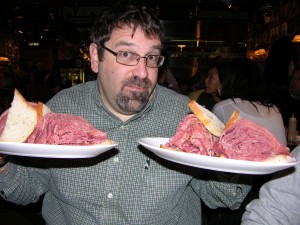
I live in Atlanta, Georgia, but my wife, kids and I generally visit New York City at least once a year.  No stop in the City would be complete without a visit to the Carnegie for a giant corned beef sandwich.  Thanks to my friend Howard Beer for alerting me to Mr.  Parker’s passing.

corned beef sandwich at the Carnegie Deli
Carnegie Deli Corned Beef Sandwich

Filed Under: Miscellaneous observations Tagged With: Carnegie Deli, corned beef sandwich, Milton Parker

  • Home
  • About Jonathan Ginsberg
  • Interesting Readings
  • Blog

Copyright © 2026 · Agency Pro on Genesis Framework · WordPress · Log in